Temptation and Fall of Man
Paradise LostTemptation and Fall of Man is the central reversal of the human story: Adam and Eve move from innocent freedom under God’s command to disobedience, shame, and the mortal condition inherited by their descendants. Satan’s strategy depends on rhetoric as much as deceit. He makes forbidden knowledge appear as liberation, then turns Eve’s love for Adam into the means by which Adam knowingly shares her transgression. The immediate result is not godlike wisdom but a damaged knowledge of good and evil, the loss of innocence, and the beginning of humanity’s long need for redemption.
Causes and Background
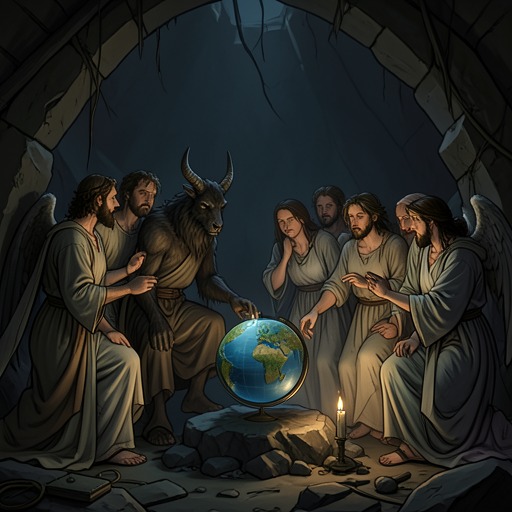
The event grows out of Satan’s continuing hostility to God and his determination to corrupt the human race. After wandering over the Earth, the fallen spirits acquire among humanity the various names and cults by which they are worshiped as false deities, extending their rebellion from Heaven into human history. Satan’s assault on Eden therefore forms part of a larger campaign: unable to overthrow God directly, he seeks to damage the new race that God has created to occupy the place left vacant by the rebellious spirits.
The immediate opportunity appears when Satan, enclosed in the form of a serpent, finds Eve alone. Her beauty and innocence briefly disarm his hatred, producing a momentary suspension of malice; the sight of a happiness not intended for him then intensifies his envy and restores his purpose. He judges Adam the more formidable target because of Adam’s greater intellectual strength, heroic courage, and physical power, while Eve seems more accessible to a fraud disguised as affection. The serpent accordingly approaches her with a beautiful, elevated appearance rather than with the later familiar crawling form.
The temptation also depends on a sacred boundary already established in Eden. Adam and Eve may eat from every other tree, but God has commanded them neither to eat nor touch the fruit of the Tree of Knowledge of Good and Evil, lest they die. The prohibition gives the tree a unique status: it is set apart from ordinary use, and its very exclusion concentrates Eve’s attention upon the knowledge it is said to contain. Human reason remains active within obedience, but Satan attempts to turn reason against the command by making the command itself appear evidence of oppression.
Satan’s Temptation of Eve
Satan begins with extravagant praise. He addresses Eve as a sovereign and presents her as a near-divine likeness of her Maker, insisting that the other creatures are too ignorant to recognize her full excellence and that only Adam can properly behold her. The flattery is calculated to isolate her from both her husband and the wider order of creation. It encourages her to imagine that her true dignity exceeds the place assigned to her, while the serpent presents himself as the exceptional creature capable of perceiving and articulating that hidden greatness.
When Eve asks how a beast can speak with human voice and reason, the serpent supplies a fabricated history. He claims that he was once an ordinary animal until he saw a splendid tree bearing beautiful fruit, followed its odor and appetite, and ate. According to his account, the fruit gave him speech, understanding, and a higher form of life. This false testimony appears persuasive because it offers apparent experience against God’s warning: the serpent claims to have eaten and remained alive, and Eve can see before her a creature who reasons and speaks.
The serpent then directly attacks the justice of God. He denies that eating will bring death and argues that God has forbidden the fruit only to keep human beings low and ignorant. He suggests that the threatened punishment is incompatible with divine goodness and that the fruit will open their eyes, making them as gods who know good and evil. The temptation therefore joins appetite to interpretation. The fruit is not merely presented as pleasant food; it is recast as intellectual liberation, a means of escaping creaturely limitation and attaining a higher status without God’s permission.
Eve’s response shows the internal movement of the temptation. She initially repeats the command accurately, but the serpent’s argument has made the prohibition itself seem to advertise the fruit’s value. She reasons that unknown good is scarcely possessed, that the serpent lives after eating, and that knowledge of good and evil would enable her to understand and avoid evil. Noon awakens her appetite, while the fruit’s smell and appearance reinforce the argument already planted in her mind. The command is no longer experienced as a wise limit but as an unjust denial of wisdom.
At last Eve reaches out, plucks the fruit, and eats. The act is marked as a wound to the Earth: Nature sighs through all her works, signaling that the consequences exceed the private decision of one person. Eve experiences delight and imagines that the Tree has granted her knowledge and access to wisdom. She even considers tending it daily and sharing its abundance with others, as though the act had opened a benevolent order of universal enlightenment. Yet she has not learned to recognize death; her first interpretation of the change remains governed by desire and expectation.
Adam’s Choice and the Value Reversal
Adam’s return supplies the event’s second and more complex decision. While waiting for Eve, he has woven a garland of flowers to adorn her, but an obscure foreboding has already troubled him. When he meets her carrying the newly gathered fruit, her face visibly bears apology and disturbance. Eve tells him that the serpent has eaten without dying and that she too has discovered enlarged perception, a fuller spirit, and what she calls an approach to godhead. She emphasizes that she sought this change chiefly for Adam and that happiness without sharing it with him would be empty.
Adam’s first reaction is horror. The garland falls from his hand, its roses scattering as he realizes that Eve has committed the fatal trespass. He sees her as suddenly lost, defaced, and devoted to death, and he recognizes that the enemy’s fraud has ruined him with her. Yet his response does not become a simple rejection. He reasons that the serpent lives after eating and that God may not destroy the highest of his earthly creatures, especially when their destruction would allow the Adversary to mock the instability of divine favor.
The decisive motive is Adam’s attachment to Eve. He declares that he will share her fate because she is flesh of his flesh and bone of his bone; to lose her would be to lose himself. His choice is therefore not the result of deception of the same kind that overcame Eve. He understands the danger more clearly, but love, fear of separation, and the conviction that their state cannot be divided prevail over obedience. The value at stake shifts from innocence and life to marital unity: Adam treats death with Eve as preferable to life without her.
Eve interprets Adam’s decision as an extraordinary proof of love. She admits that she would rather have borne the danger alone than have endangered his peace, but his willingness to incur divine displeasure for her sake moves her to celebrate their union as one heart and one soul. Her language turns disobedience into a shared trial and makes the forbidden act a test through which their love has supposedly been revealed. The scene’s tragic irony lies in the distance between that interpretation and the actual consequence: the act that seems to confirm equality and intimacy produces guilt, disorder, and the loss of their former innocence.
Adam then eats, not because the serpent has deceived him, but because he is overcome by Eve’s charm and refuses to be separated from her. The Earth trembles again, the sky darkens, thunder mutters, and rain falls as the mortal sin is completed. Both eat freely and imagine that divinity is growing within them, but the fruit’s first actual operation is carnal desire. Their perception of one another changes from innocent love to lust, and the new appetite immediately reveals that their supposed ascent has become a descent into disordered desire.
Immediate Consequences in Eden
After their amorous play beneath a shaded bank, sleep gives way to awakening. The exhilarating force of the fruit fades, and Adam and Eve discover that their eyes have opened in a sense opposite to the one promised by Satan. Innocence, native righteousness, confidence, honor, and the protective veil that had kept them from knowing evil are gone. They know good and evil, but the knowledge is experienced as the loss of good and the acquisition of evil rather than as an increase in godlike wisdom.
Their first response is shame. They sit silent and confounded, then seek leaves broad enough to cover their nakedness. Adam chooses the fig tree, described through its spreading branches and rooted shoots as a great natural shelter; its leaves are sewn together around their waists. The covering is explicitly inadequate. It conceals the body only superficially while exposing the deeper reality of guilt, and it stands in painful contrast to the glory of their former nakedness.
The Fall thus changes both the moral and bodily meaning of their relationship. Before the eating, love is presented as innocent, mutual, and integrated with the harmony of creation. Afterward, desire becomes self-conscious and possessive, while their bodies become sources of embarrassment. The sequence from fruit to intoxication, from intoxication to lust, and from lust to shame gives the event a rapid value reversal: the promised increase of life becomes the discovery of vulnerability, and the imagined equality with gods ends in concealment before one another and before God.
Historical and Theological Consequences
The event is not confined to Adam and Eve’s immediate experience. In the vision later shown to Adam by Michael, the Fall becomes the source of corruption in their descendants. Michael reveals Cain and Abel, brothers born from Adam’s line, at an altar where Abel’s sincere offering is accepted while Cain’s is not. Envy turns brother against brother, and Cain kills Abel with a stone. Adam learns that human violence will arise from the original sin even in those who did not themselves touch the forbidden tree.
The same vision expands the meaning of death. Michael identifies Abel’s murder as death in its first human form, then describes many later paths to the grave: violent force, fire, flood, famine, intemperance, and disease. A house filled with sufferers makes visible the misery that Eve’s inabstinence will bring upon humanity. Mortality is therefore not a single punishment but a condition with numerous physical and historical manifestations, spreading through bodies, families, societies, and generations.
The Fall also produces the need for law and mediation. Through the future history revealed to Adam, human sin persists among the descendants of Abraham, so divine law is given to expose natural depravity rather than to remove it by its own power. The rites of sacrifice, including the blood of bulls and goats, function as shadows of a more precious payment. At Sinai, God establishes laws and rites and allows the Tabernacle to stand among mortal people, with the Ark, the testimony of the covenant, the mercy-seat, Cherubim, and lamps representing heavenly fire. The sanctuary makes divine presence possible within a sinful human history, but it also confirms how far humanity has fallen from its original condition.
The catastrophe finally becomes the ground of the redemption announced by God and the Son of God. God declares that humanity need not be wholly lost: grace may renew its ruined powers, though deliverance must be attributed to divine grace rather than human merit. Because disobedience incurs death, the Son of God offers life for life, agreeing to become human, suffer death, and satisfy the penalty that humanity cannot pay. His resurrection will defeat Death, overcome Satan’s works, and make salvation available to those who receive it by faith. The Fall therefore remains an irreversible loss within the plot, but it is also absorbed into a larger movement in which good will arise from evil and creation will ultimately be renewed.
Narrative Frame and Significance
The event is presented chiefly through main narration, but its meaning is later refracted through Michael’s revelatory vision to Adam. That retrospective vision confirms that the private act beside the Tree has consequences reaching from the first family to Cain and Abel, the laws given through Moses, the Tabernacle, the Incarnation, the Passion and Resurrection of Christ, the Ascension of Christ, and the final restoration of creation. The scene is thus both an intimate domestic crisis and the originating event of sacred history.
As a temptation plot, the episode is built from a contest over interpretation. Satan does not remove Eve’s freedom; he supplies a false account of what freedom, knowledge, death, and divine justice mean. Eve then reasons within the language of liberation, while Adam reasons within the language of irrevocable love. Their error is therefore intellectual, affective, and volitional at once. They choose, but their choices are shaped by appetite, vanity, fear of limitation, and the desire not to be divided.
The event’s deepest irony is that the forbidden fruit does provide knowledge, but only as an anguished recognition of lost innocence. Adam’s later sight of Abel’s death teaches him that the consequences of the act cannot be contained within Eden, while Michael’s account of the Son of God shows that the first disobedience will be answered by perfect obedience and sacrificial love. The Fall is consequently the book’s great descent and its governing theological hinge: the moment when humanity loses Paradise, and the moment from which the possibility of a greater restoration begins.